
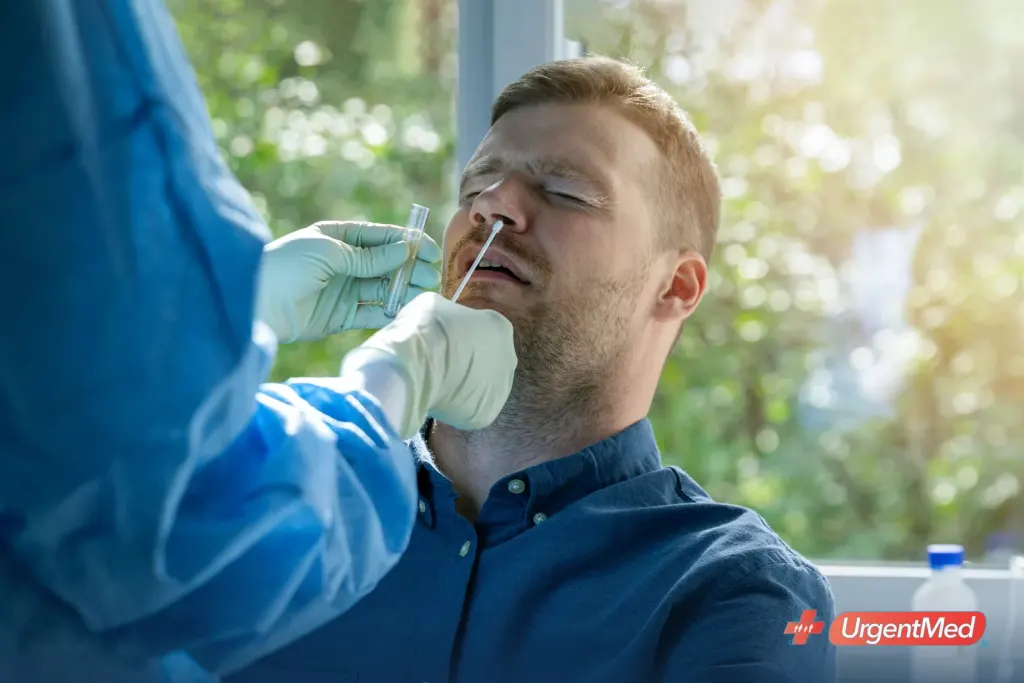
RSV — respiratory syncytial virus — is a common respiratory infection that most people have had by the age of two. In healthy adults it usually feels like a heavy cold. In babies, in young children and in older adults it can be considerably more than that, which is why testing is worth doing rather than assuming. Both UrgentMed clinics run a rapid RSV test on site and give you the result during your visit, seven days a week, walk-in. Adults and children from age 3 are seen; infants and toddlers under 3 are tested by their pediatrician or, when breathing is labored, in the emergency room.
Rapid RSV testing at both Broward clinics
- A nasal swab, read during your visit — no appointment, no referral, no waiting for a call back.
- Tested alongside the other winter viruses when the picture warrants it: influenza and COVID-19 are run from the same visit, because the three are indistinguishable by symptoms alone.
- Examination that goes further than the swab — breathing effort, oxygen saturation, hydration and chest sounds, which is what actually decides how serious this is.
- Same-visit care — nebulized treatment where it is indicated (see breathing treatments), fluids for dehydration, and chest imaging on site if the examination calls for it.
- Care for adults and children from age 3, seven days a week — see urgent care for children.
Why the result changes what happens next
Knowing which virus it is does not produce a cure — there is no antibiotic for any of them — but it changes several practical things:
- It stops antibiotics being given for no reason, which matters more than it sounds.
- It tells you what to watch for and for how long, since RSV typically peaks around days three to five, later than most people expect.
- It changes the threshold for coming back. A young child or an older adult with RSV is watched more closely than the same person with a common cold.
- It guides isolation at home, at daycare and at work, and it is what a daycare or employer usually wants documented.
- It separates RSV from COVID-19 and influenza, one of which does have specific antiviral treatment when it is caught early.
RSV symptoms in adults and children — and who needs a test
The usual illness
- Runny or congested nose.
- A persistent, often barking or wet-sounding chest.
- Sneezing and sore throat.
- Temperature, often mild in adults.
- Reduced appetite and low energy.
- Symptoms that build over several days rather than arriving all at once.
People who need a closer look
- Children under two, and especially under six months.
- Anyone born prematurely, or with a heart or lung condition.
- Adults over 65, and anyone with a chronic lung or heart condition.
- Anyone with a weakened immune system.
- Anyone whose breathing is fast, labored or noisy.
- Anyone not drinking enough — in young children, fewer wet diapers is the sign to act on.
In a young child the danger sign is the breathing, not the temperature. Fast breathing, the skin pulling in around the ribs or at the base of the neck, flaring nostrils, grunting, or long pauses between breaths all mean be seen immediately — call 911 if they are struggling.
What the RSV test visit involves
- History and examination first — how many days in, how the breathing is, how much is being taken in and kept down.
- Vital signs including oxygen saturation, which in this illness tells you more than any swab.
- A nasal swab for the rapid test, with influenza and COVID-19 tested at the same time where appropriate.
- The result and the examination together decide the plan — a positive swab in a comfortable, well-hydrated patient is managed very differently from a negative one in a child who is working to breathe.
- Treatment at the visit where it is indicated, and a clear written plan where it is not.
- Documentation for school, daycare or work, and specific instructions on what would bring you back.
Care at home, and when to come back
- Fluids in small, frequent amounts — more important than any medicine in this illness.
- Saline drops and gentle suction for a blocked nose in a small child, particularly before feeds and sleep.
- Upright positioning for comfort, and a humidifier if it helps.
- Fever control appropriate to age and weight — ask rather than guess with a small child.
- Come back if the breathing gets faster or harder, if intake drops off, if the illness is not turning the corner after five to seven days, or if a temperature returns after settling.
- RSV immunization is not part of the vaccine stock at either clinic — see the vaccines page for what is available here, and ask your own physician or pharmacy about RSV protection.
Is there a medical test for RSV? The swab test and the PCR
Yes — two kinds. The rapid antigen test is a nasal swab read in the clinic within minutes. It is the test both UrgentMed clinics run during the visit, and it is most accurate in young children, who carry the most virus. The RSV PCR detects the virus’s genetic material and is more sensitive, especially in adults, whose rapid tests are more often falsely negative. It is sent to the reference laboratory, usually as part of a respiratory panel that also covers influenza and COVID-19, and the result returns in a few business days. When an adult with a convincing illness has a negative rapid test, the provider says whether a PCR is worth sending. Neither test is needed to confirm a diagnosis in a mild cold; testing is done when the answer changes the plan. MedlinePlus has a plain-language overview of RSV.
When to go to the emergency room instead
- Struggling to breathe: fast or labored breathing, skin pulling in around the ribs or neck, flaring nostrils, or grunting.
- Pauses in breathing, in a baby of any age.
- Blue or gray lips, face or fingertips — call 911.
- Unable to drink, or markedly fewer wet diapers in a small child.
- Very drowsy, floppy, or unusually difficult to wake.
- Any child under three months with a temperature.
- Chest pain, or severe breathlessness in an adult.
Urgent care is for problems that need attention today but are not life-threatening. If you think you may be having an emergency, call 911 — do not drive yourself.
Walk in at either Broward clinic
Both clinics are open seven days a week — Davie at 5149 S University Drive (Renaissance Plaza, just off I-595) and Plantation at 10199 Cleary Boulevard, Suite 10. Both serve Davie, Plantation, Cooper City, Weston, Sunrise, Southwest Ranches, Pembroke Pines, Fort Lauderdale and the surrounding Broward County communities. Spanish-speaking staff work at both clinics. Hours, maps and parking, or hold your place online before you come in.
Insurance and self-pay
Most major plans are accepted, along with workers’ compensation and auto (PIP) claims; benefits are verified at check-in. Self-pay is welcome and the price is quoted at the front desk before you are seen. Plans and payment.
Sources: CDC — Respiratory syncytial virus (RSV) · MedlinePlus — RSV infections