
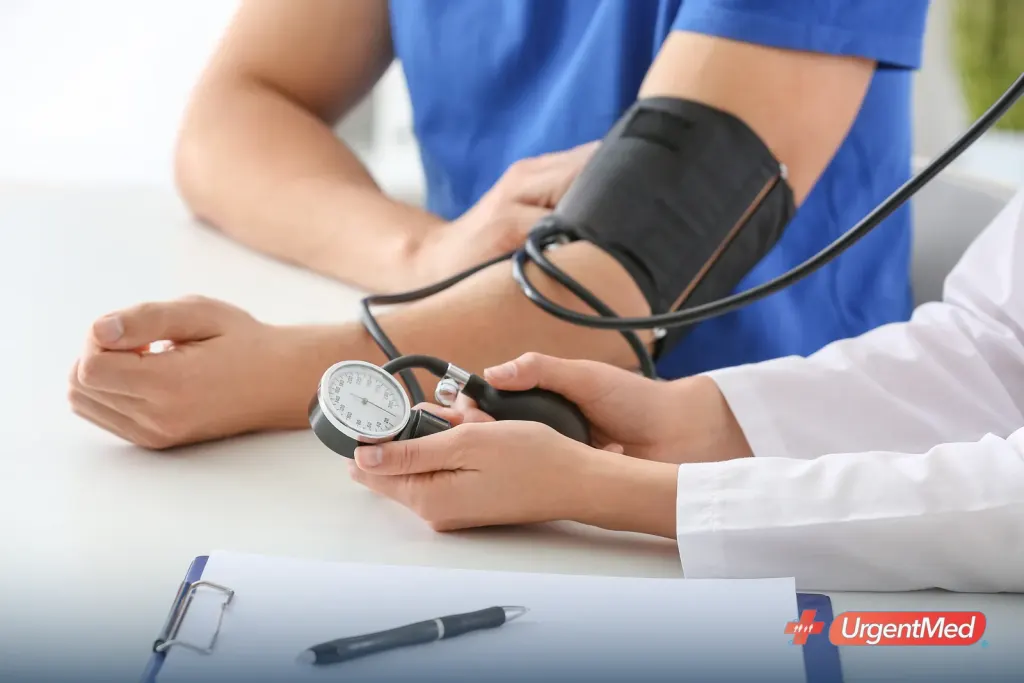
UrgentMed checks blood pressure at both Broward clinics, seven days a week, with no appointment — whether a home monitor has given you a number you did not expect, a pharmacy machine has told you to see someone, or a physical has flagged a reading. This is a walk-in check and a same-day assessment, not ongoing hypertension management: the long-term treatment of high blood pressure belongs with a primary care physician. What a walk-in visit gives you is a properly taken reading today, an examination, and a clear answer about whether this needs an emergency department, your physician this week, or simply a recheck.
A blood pressure reading taken properly
Most alarming numbers are taken badly. A blood pressure reading is only worth acting on if the cuff fits the arm, the arm is supported at heart height, the feet are flat, and the person has been sitting quietly for a few minutes first — and a single high reading is not hypertension. At the visit the reading is repeated, taken in both arms where that is informative, and interpreted alongside your pulse, your history and what you have taken today, including decongestants, caffeine, nicotine and stimulants, which move the number more than most people expect.
What can be done the same visit
- Repeat, correctly taken blood pressure readings, and an explanation of what they mean.
- Examination — heart, lungs, and the symptoms that separate a number from an emergency.
- EKG on site when the picture calls for it, read during the visit.
- Blood work — kidney function and electrolytes, where relevant.
- Blood sugar, since the two travel together — see blood sugar and A1c testing.
- A clearance reading for a DOT physical or an employer form that has been held up by blood pressure.
When a high blood pressure reading is an emergency
The number alone is not what decides it — symptoms are. A very high reading with chest pain, breathlessness, severe headache, visual change, weakness or numbness on one side, difficulty speaking, or confusion is a medical emergency and needs 911, not a drive to urgent care. A very high reading in someone who feels well is still worth having looked at today, and that is a visit this clinic is for.
What happens after the visit
You leave with the readings written down, an explanation of where they sit, treatment for anything that needs treating today, and a named next step — your own physician within a defined timeframe, a referral, or a recheck here. Bringing a week of home readings to that follow-up is worth more than any single visit: it is what a physician needs to decide whether treatment is warranted. If you have no physician, say so at the visit — starting that relationship is frequently the most valuable thing the visit produces.
What this page is not
UrgentMed does not manage hypertension over time, does not titrate blood pressure medication, and is not a substitute for the physician doing that. Nobody should stop or change a prescribed medication because of a single walk-in reading.
Urgent care for high blood pressure — what a walk-in visit can and cannot do
A walk-in visit can measure the pressure properly, find out why it is high today, and treat what needs treating now. It ends with a clear next stop: your own physician, a specialist or the emergency room. It cannot replace ongoing care. Hypertension is managed over months by a physician who knows you, and the clinics say so rather than starting long-term medication at a single visit.
- Normal — under 120/80.
- Elevated — 120 to 129 over under 80.
- Stage 1 hypertension — 130 to 139, or 80 to 89.
- Stage 2 hypertension — 140 or higher, or 90 or higher.
- Hypertensive crisis — above 180/120, which needs immediate evaluation.
Those are the American Heart Association categories; MedlinePlus explains what each means.
When to go to the emergency room instead
- A high reading together with chest pain or pressure.
- Sudden severe headache, visual change, or confusion.
- Weakness, numbness or drooping on one side, or difficulty speaking — call 911 for stroke symptoms.
- Severe shortness of breath, or breathlessness lying flat.
- Fainting, or a heart rate that is very fast or very slow with the high reading.
Urgent care is for problems that need attention today but are not life-threatening. If you think you may be having an emergency, call 911 — do not drive yourself.
Walk in at either Broward clinic
Both clinics are open seven days a week — Davie at 5149 S University Drive (Renaissance Plaza, just off I-595) and Plantation at 10199 Cleary Boulevard, Suite 10. Both serve Davie, Plantation, Cooper City, Weston, Sunrise, Southwest Ranches, Pembroke Pines, Fort Lauderdale and the surrounding Broward County communities. Spanish-speaking staff work at both clinics. Hours, maps and parking, or hold your place online before you come in.
Insurance and self-pay
Most major plans are accepted, along with workers’ compensation and auto (PIP) claims; benefits are verified at check-in. Self-pay is welcome and the price is quoted at the front desk before you are seen. Plans and payment.
Sources: American Heart Association — Understanding blood pressure readings