
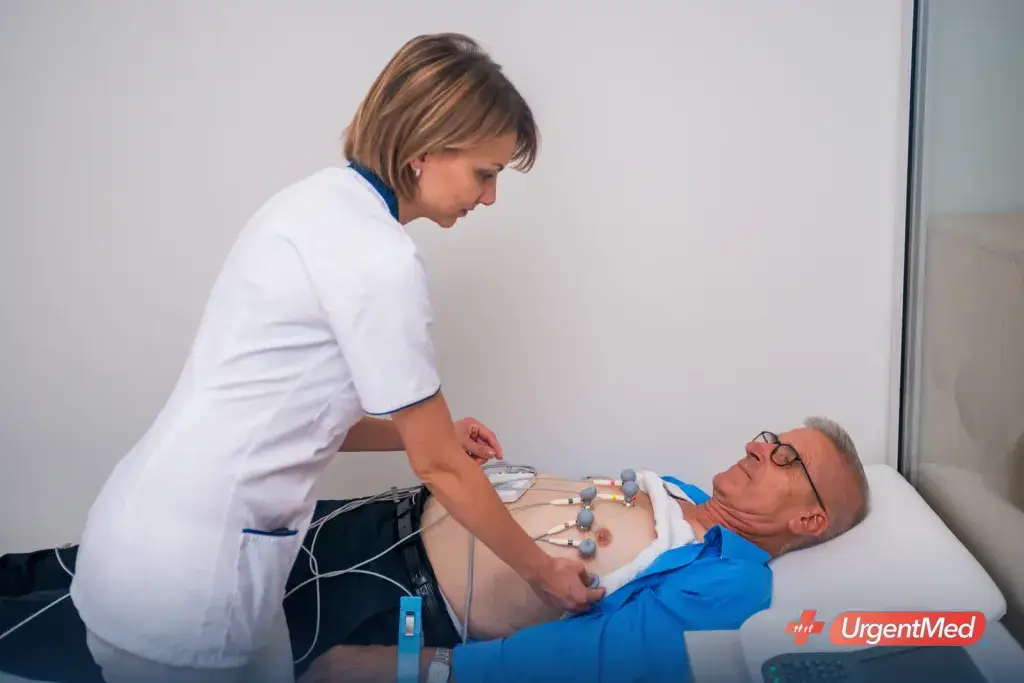
An electrocardiogram — EKG, or ECG — records your heart’s electrical activity through ten stickers on the skin. It takes about a minute, nothing is injected and no current passes into you. Both UrgentMed clinics record a full 12-lead EKG on site as a walk-in visit, seven days a week, and a provider reads the tracing and explains it before you leave, whether you are here for a form, a certification or a symptom that has been bothering you.
Walk-in EKG at both Broward clinics
No appointment and no referral are needed. The equipment, the staff trained to run it and the provider who reads it are at both locations, so you are not sent on to a hospital or a cardiology office for the recording itself.
- 12-lead recording on site — the standard tracing a clinician, surgeon or examiner expects, not a single-lead screening strip.
- Read during the visit by the provider who examines you, in the context of your history and vital signs.
- A copy leaves with you — printed for your file, and sent to the surgeon, employer, examiner or specialist who asked for it.
- Same-visit testing alongside it where the reason calls for it: blood work and digital imaging are also on site.
- Seven days a week, evenings and weekends included — the reason most people find us by searching for a walk-in EKG in the first place.
What an electrocardiogram records
The tracing is a picture of the heart’s electrical timing across roughly ten seconds. Read alongside your symptoms, history and examination, it can show:
What it can show
- The rate — how fast the heart is beating at that moment.
- The rhythm — whether beats are regular, and whether extra or skipped beats are present.
- Conduction — how the electrical signal travels through the heart, including blocks and delays.
- Patterns suggesting the heart muscle has been strained or injured, now or in the past.
- Changes associated with certain medications and electrolyte disturbances.
What it cannot do
- It does not measure blocked arteries. A normal tracing does not rule out coronary disease.
- It records only the moment it is taken — an intermittent rhythm problem can be missed entirely.
- It is not a substitute for a cardiology evaluation, an echocardiogram or a stress test.
- It does not, by itself, clear anyone for surgery or certification. It is one input the examining provider uses.
This matters and is worth saying plainly: a normal EKG is reassuring, not proof that your heart is healthy. If your symptoms continue, come back or see a cardiologist — do not treat one normal tracing as the end of the question.
Reasons an EKG is done here
For a form, a clearance or a certification
- Evaluation before an operation, when the surgeon or anesthesiologist asks for one — see medical clearance for surgery.
- Commercial driver certification when the examiner’s findings call for it — see DOT and CDL exams.
- Student athlete screening under the Florida form that now includes a heart-screening element — the sports physical and the EL1 screening are done in one visit on the school and sports physicals page.
- Occupational and licensing exams that specify one, including fire service, law enforcement and diving medicals.
- A baseline before starting a medication that can affect cardiac conduction.
- Annual and executive physicals where a tracing is part of the package.
For symptoms, the same day
- A racing, pounding, fluttering or skipping heartbeat.
- Lightheadedness or dizziness, particularly on standing or with exertion.
- A near-faint, or a faint you have recovered from.
- Chest discomfort that is mild, has settled, and is not an emergency — see the emergency section below first.
- Unusual fatigue or reduced exercise tolerance you cannot explain.
- Readings from a watch or home device that flagged something and left you worried.
If your reason is a reading from a home cuff rather than your pulse, the blood-pressure evaluation page is the better starting point — an EKG answers a different question.
What happens during the EKG
- Check in and say why you are here — the symptom, or the form that requires the tracing. Bring the form; it tells us what the examiner needs.
- You lie down and ten electrodes go on — chest, arms and ankles. Small areas may be wiped or, occasionally, shaved so the stickers make contact.
- You stay still and breathe normally for about a minute. The recording itself is silent and painless. Nothing enters your body.
- The tracing prints immediately and the provider reads it — with your history, your examination and your vital signs, not on its own.
- You are told what it shows before you leave, in plain language, along with what happens next.
- The electrodes come off and you go — no recovery time, no restrictions, and you can drive yourself.
Wear or bring a top that opens at the front if you can; it makes placement quicker. Lotions and oils on the chest can stop electrodes sticking, so skip them that morning if you know you are coming in.
Reading the tracing, and what happens next
There are three honest outcomes, and you are told which one you are in before you leave:
- Normal for you — the tracing is documented, signed and given to you or sent where it needs to go.
- A finding that needs context — many findings are long-standing and harmless. Where an old tracing exists, comparison is the fastest way to know; bring one if you have it.
- A finding that needs more than urgent care can give — you are told directly, given the tracing, and referred for cardiology evaluation. Where the finding is acute, you are sent to the emergency department from here and we call ahead.
For paperwork, the signed tracing and the provider’s note go out the same day. If the requirement also includes laboratory testing or a chest film, both are done in the same visit rather than sending you elsewhere and starting again.
EKG for students and young athletes
Florida’s athletic participation paperwork now includes a heart-screening element, and some programs, clubs and colleges ask for a tracing outright. Both clinics record it at the same visit as the examination, so a family is not making two trips. Details of the form itself, and what is and is not required, are on the school and sports physical page; care for children is available at both locations seven days a week.
What to bring
- The form, letter or requirement that asks for the tracing — it names the format the examiner expects.
- A list of your medications, including anything over the counter, and any known heart condition.
- A previous EKG if you have one, on paper or on your phone. Comparison answers more questions than a fresh tracing alone.
- Photo ID and your insurance card; the employer authorization if an employer is paying.
How much does an EKG cost, and is it covered?
When an EKG is part of a visit for symptoms, most insurance plans cover it as part of that visit. When it is for a form — a sports physical, a pre-operative clearance, an employer or licensing exam — it is usually self-pay or billed to the employer account, and the front desk quotes the price before the tracing is taken. UrgentMed is not a free screening program; what you get for the price is a 12-lead tracing read by a provider before you leave, with a copy in your hand. MedlinePlus explains what an electrocardiogram shows.
When to go to the emergency room instead
- Chest pain or pressure — especially with sweating, nausea, or pain spreading to the arm, neck or jaw.
- Severe difficulty breathing, or breathlessness that came on suddenly.
- Fainting, or a near-faint together with chest symptoms.
- A very fast or irregular heartbeat that will not settle.
- Sudden weakness, facial droop, or trouble speaking — call 911 for stroke symptoms.
- Anything you believe may be a heart attack. Call 911; do not drive yourself and do not come here first.
Urgent care is for problems that need attention today but are not life-threatening. If you think you may be having an emergency, call 911 — do not drive yourself.
Walk in at either Broward clinic
Both clinics are open seven days a week — Davie at 5149 S University Drive (Renaissance Plaza, just south of Griffin Road) and Plantation at 10199 Cleary Boulevard, Suite 10. Both serve Davie, Plantation, Cooper City, Weston, Sunrise, Southwest Ranches, Pembroke Pines, Fort Lauderdale and the surrounding Broward County communities. Spanish-speaking staff work at both clinics. Hours, maps and parking, or hold your place online before you come in.
Insurance and self-pay
Most major plans are accepted, along with workers’ compensation and auto (PIP) claims. When the tracing is part of a licensing, certification or program exam it is usually self-pay, and the front desk quotes the price before you are seen — ask, and you will be told. Plans and payment.
Sources: MedlinePlus — Electrocardiogram