
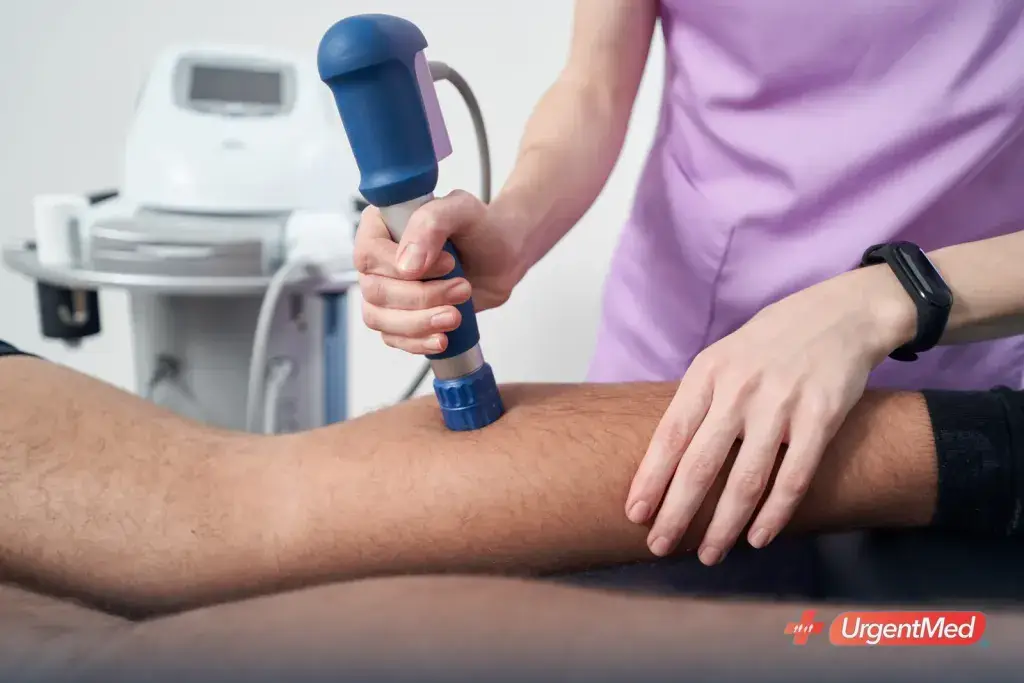
Shockwave therapy — extracorporeal shockwave therapy, or ESWT — treats stubborn tendon and heel pain with acoustic pulses applied to the skin over the painful area. It is non-invasive, takes about fifteen minutes, and is available at both UrgentMed clinics in Davie and Plantation for patients whose plantar fasciitis, tennis elbow or tendinopathy has not settled with rest, stretching and anti-inflammatories.
Conditions shockwave therapy is used for
- Plantar fasciitis and heel pain that has lasted more than a few months.
- Achilles tendinopathy — mid-portion and insertional.
- Tennis elbow and golfer’s elbow (lateral and medial epicondylitis).
- Patellar tendinopathy (“jumper’s knee”) and quadriceps tendon pain.
- Calcific tendinopathy of the shoulder and rotator-cuff tendinopathy.
- Greater trochanteric pain (outer hip) and hamstring tendinopathy.
It is most useful for chronic, overuse-type tendon pain. An acute sprain or fracture is treated differently, and an X-ray is taken first when the provider needs to rule one out.
How a shockwave treatment works
- The provider examines the area and confirms shockwave is appropriate — it is not used over open growth plates, a pregnancy, a pacemaker, active infection or a blood-clotting disorder.
- Gel is applied and the handpiece delivers a series of acoustic pulses to the painful spot; most patients describe it as a firm tapping that is uncomfortable but tolerable, and the intensity is adjusted to you.
- A session lasts roughly ten to fifteen minutes. No anesthetic, no needle and no downtime — you walk out and can return to normal activity, avoiding hard training for a day or two.
- A course is usually three to five sessions a week apart, with improvement typically building over several weeks after the last session rather than immediately.
Shockwave, injections or a splint — which one?
For a first flare the provider usually starts with rest, stretching, a night splint or brace and anti-inflammatories. When pain persists, a corticosteroid injection gives faster relief but is limited in how often it can be repeated; shockwave is the option when you want to avoid repeated steroid injections or the tendon has not responded to them. Work-related tendon injuries under workers’ compensation can be treated the same way with the carrier’s authorization.
Shockwave therapy in Davie and Plantation
- Available at both clinics, seven days a week — evaluation and the first session can happen at the same walk-in visit when appropriate.
- X-ray on site to rule out a fracture or bone spur before treatment starts.
- Injection therapy, splinting and orthopedic referral under the same roof when shockwave is not the answer.
- Self-pay pricing per session and per course is quoted at the front desk; shockwave is not covered by most insurance plans.
Walk in at either Broward clinic
Both clinics are open seven days a week — Davie at 5149 S University Drive (Renaissance Plaza, just south of Griffin Road) and Plantation at 10199 Cleary Boulevard, Suite 10. Both serve Davie, Plantation, Cooper City, Weston, Sunrise, Southwest Ranches, Pembroke Pines and the surrounding Broward County communities. Hours, maps and parking.
Insurance and self-pay
Shockwave therapy is generally a self-pay service — most insurance plans do not cover it — and the per-session and course pricing is quoted at the front desk before treatment. Workers’ compensation cases are treated with carrier authorization.