
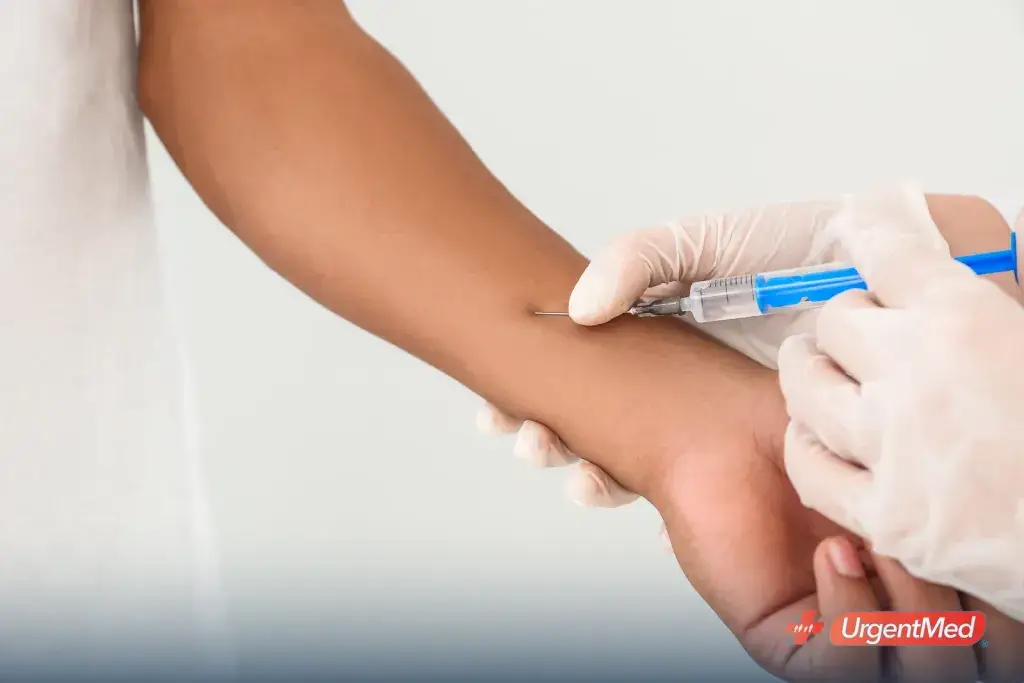
Tuberculosis screening — a TB test — is one of the most common things a school, a clinical program or an employer asks for, and it is the item most likely to hold up a start date. Both UrgentMed clinics place and read the PPD test (the TB skin test, also called the Mantoux test) as a walk-in visit, draw the single-visit TB blood test, and have chest imaging on site if a result calls for it — seven days a week, so the reading window never falls on a day we are closed.
Two ways to be tested — and which one you need
PPD test (TB skin test, Mantoux)
- A small amount of fluid placed just under the skin of the forearm — what many people call a TB shot or PPD shot. It takes a couple of minutes. It is a test, not a vaccine.
- You must return in 48 to 72 hours for a provider to measure and document it.
- The cheapest option, and the one most schools and programs still name by default.
- Two visits — and the return visit is not optional. Read outside the window, the test is invalid and has to be repeated from the start.
- Prior BCG vaccination can produce a positive reaction, which is one reason the blood test is often preferred.
TB blood test (IGRA: QuantiFERON or T-SPOT)
- One visit, one draw, no return trip — QuantiFERON-TB Gold or T-SPOT depending on the laboratory.
- Not affected by previous BCG vaccination.
- The practical choice when you travel, work shifts, or cannot guarantee coming back inside the window.
- Drawn here and sent to the reference laboratory — see on-site collection and panels — usually back in a few business days, with STAT available when it is needed.
- Accepted by most healthcare programs — confirm with yours before choosing, since a few still specify the skin test.
Check what your program actually requires before you choose. The most common wasted trip is a skin test placed for a program that wanted the blood test, or a single test placed where two-step was required.
Two-step TB test for healthcare onboarding
Hospitals, nursing programs and long-term-care employers often require two-step testing for anyone without a documented recent test. It exists to catch a weakened reaction that only shows on a second placement — not to be awkward:
- First placement, then the reading visit 48 to 72 hours later.
- If the first is negative, a second placement roughly one to three weeks later.
- A second reading visit 48 to 72 hours after that.
- Documentation of both, in the format your program requires.
That is four visits over one to three weeks, which is why it is the single most common reason a start date slips. Start it the week you get the packet, not the week before you begin. Everything else in a clinical onboarding packet — the examination, immunity titers, hepatitis B, the drug screen — is done here too; see nursing school and healthcare worker physicals.
Who is usually asked for it
- Healthcare and long-term-care employees and new hires.
- Nursing, medical, dental and allied-health students before clinical placement.
- Teachers, childcare and school staff.
- Volunteers going into clinical or care settings.
- People starting work in shelters, correctional or residential settings.
- Applicants completing the USCIS immigration medical examination, where testing follows the civil surgeon protocol.
- Anyone with a known exposure, or symptoms that warrant screening.
- Employers running a program — see screenings for employers and new-hire physicals.
Positive TB test: what happens next
A positive screen means exposure at some point — it does not mean you are ill or infectious. What follows is a defined path, and it is handled here:
- A chest film on site the same day where it is indicated, read during the visit; see on-site imaging.
- Examination and history — symptoms, exposures, travel and previous testing.
- Documentation for your program recording the result and the follow-up, which is usually what the program actually needs.
- Referral to the county health department or to infectious disease for treatment decisions where that is the appropriate next step. Florida’s health department program handles latent and active tuberculosis directly.
- Once positive, always positive on skin testing — future programs need the documentation, not another placement. Keep the paperwork; it saves you this process every time.
What to bring
- The program or employer form, and its statement of which test is required.
- Any record of previous TB testing, a previous positive result, or BCG vaccination.
- Your immunization record if the same packet asks for other items — immunity titers and vaccines are done here in the same visit.
- Photo ID; the employer authorization if your employer is paying.
- Your calendar — book the reading visit before you leave if you are having a skin test.
Where can I get a TB test near me?
At UrgentMed Davie (5149 S University Drive, just south of Griffin Road) or UrgentMed Plantation (10199 Cleary Boulevard, Suite 10), as a walk-in, seven days a week. Both clinics place and read the PPD skin test and draw the single-visit blood test. For a skin test, plan the visit so the reading falls 48 to 72 hours later — on any day, because both clinics are open every day. MedlinePlus has an overview of tuberculosis testing and treatment.
When to go to the emergency room instead
- Coughing up blood.
- Severe difficulty breathing.
- Chest pain with a temperature and severe illness.
- Weeks of night sweats and weight loss with a persistent illness — be evaluated promptly, and go to the emergency department if you are severely unwell.
Urgent care is for problems that need attention today but are not life-threatening. If you think you may be having an emergency, call 911 — do not drive yourself.
Walk in at either Broward clinic
Both clinics are open seven days a week — Davie at 5149 S University Drive (Renaissance Plaza, just south of Griffin Road) and Plantation at 10199 Cleary Boulevard, Suite 10. Both serve Davie, Plantation, Cooper City, Weston, Sunrise, Southwest Ranches, Pembroke Pines, Fort Lauderdale and the surrounding Broward County communities. Spanish-speaking staff work at both clinics. Hours, maps and parking, or hold your place online before you come in.
Insurance and self-pay
Employer-ordered testing is billed to the employer account — set one up here. For everyone else, most major plans are accepted and self-pay is quoted at the front desk before you are seen. Plans and payment.
Sources: CDC — Testing for tuberculosis · MedlinePlus — Tuberculosis