
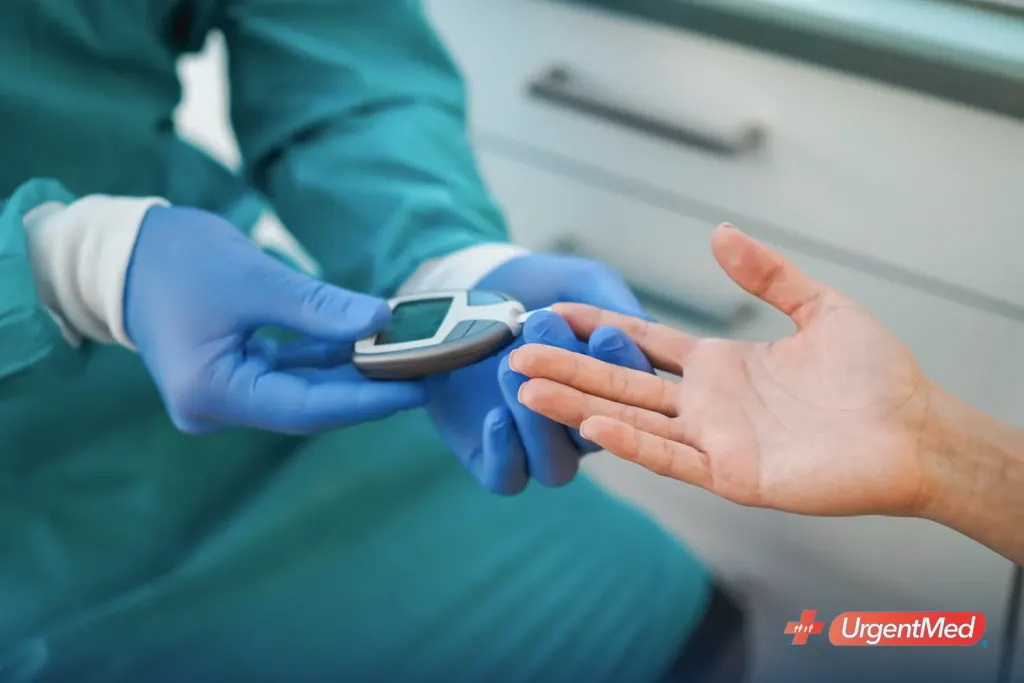
UrgentMed checks blood sugar and collects A1c testing at both Broward clinics, seven days a week, with no appointment. This is walk-in evaluation rather than diabetes management: a provider measures where you are today, examines you, treats what needs treating now, and tells you plainly whether the next step is your own physician, an endocrinologist, or the emergency department. Ongoing diabetes care belongs with a primary care physician or an endocrinologist — what a walk-in clinic adds is a reading and an assessment today, when waiting for an appointment is the problem.
Blood sugar and what else we can check the same day
- Blood glucose — a finger-stick reading taken and explained during the visit.
- A1c — collected here, giving the three-month picture rather than a single moment.
- Urinalysis — including a check for glucose and ketones when the picture calls for it.
- Basic metabolic and kidney panels through on-site blood work.
- Examination of a foot wound, sore or infection that is not healing — see wound care.
- Blood pressure, which travels with blood sugar more often than not — see blood pressure checks.
When a walk-in blood sugar check is the right call
Come in the same day when a reading is far outside your usual range and you do not know why; when you feel unwell with thirst, frequent urination, blurred vision or unexplained weight loss; when illness or a missed dose has thrown your numbers off; when a cut, blister or foot sore is not healing; or when a form, an employer or a physical has asked for a blood sugar or A1c and you have nowhere to get it done today. A first-ever high reading also belongs here — someone has to look at it, and the wait for a new-patient appointment is usually the reason it goes unlooked-at.
What a blood sugar visit actually involves
The provider takes your history, including anything you already take, measures your glucose and your vital signs, examines you with attention to the things a raised blood sugar shows up in — feet, skin, hydration — and orders the testing the picture calls for. You leave with the numbers, an explanation of what they mean in your circumstances, treatment for anything treatable today, and a written plan naming who should see you next and how soon. Results from send-out panels come back in a few business days, with STAT available when the situation calls for it, and a provider reviews them before you hear anything.
What this page is not
UrgentMed does not run a diabetes program, does not manage insulin regimens over time, and does not replace an endocrinologist. Nobody should stop or change a prescribed medication on the strength of a walk-in reading. If you do not have a physician managing your diabetes, that is worth saying at the visit — getting that relationship started is often the most useful thing to come out of it.
What is an A1c, and what do the numbers mean?
The hemoglobin A1c is a blood test that reflects your average blood sugar over the past two to three months. That is why it is the test used to diagnose diabetes and to see whether treatment is working. The American Diabetes Association ranges are: below 5.7% normal; 5.7% to 6.4% prediabetes; 6.5% or higher on two tests, diabetes. A single high reading is not a diagnosis — the provider repeats or confirms it, and tells you what the number means for you. Both clinics draw the A1c on site; the MedlinePlus A1c guide explains the test in more detail.
When to go to the emergency room instead
- Vomiting, deep or rapid breathing, abdominal pain, or a fruity smell on the breath with a high reading — these can be diabetic ketoacidosis, which is an emergency.
- Confusion, seizure, or someone who cannot be woken with a low reading.
- A low blood sugar that does not come back up after eating or drinking something sugary.
- A foot wound with spreading redness, fever, black tissue, or a bad smell.
- Chest pain or stroke symptoms, which need 911 regardless of the blood sugar.
Urgent care is for problems that need attention today but are not life-threatening. If you think you may be having an emergency, call 911 — do not drive yourself.
Walk in at either Broward clinic
Both clinics are open seven days a week — Davie at 5149 S University Drive (Renaissance Plaza, just off I-595) and Plantation at 10199 Cleary Boulevard, Suite 10. Both serve Davie, Plantation, Cooper City, Weston, Sunrise, Southwest Ranches, Pembroke Pines, Fort Lauderdale and the surrounding Broward County communities. Spanish-speaking staff work at both clinics. Hours, maps and parking, or hold your place online before you come in.
Insurance and self-pay
Most major plans are accepted, along with workers’ compensation and auto (PIP) claims; benefits are verified at check-in. Self-pay is welcome and the price is quoted at the front desk before you are seen. Plans and payment.
Sources: American Diabetes Association — Diagnosis · MedlinePlus — Hemoglobin A1c test