
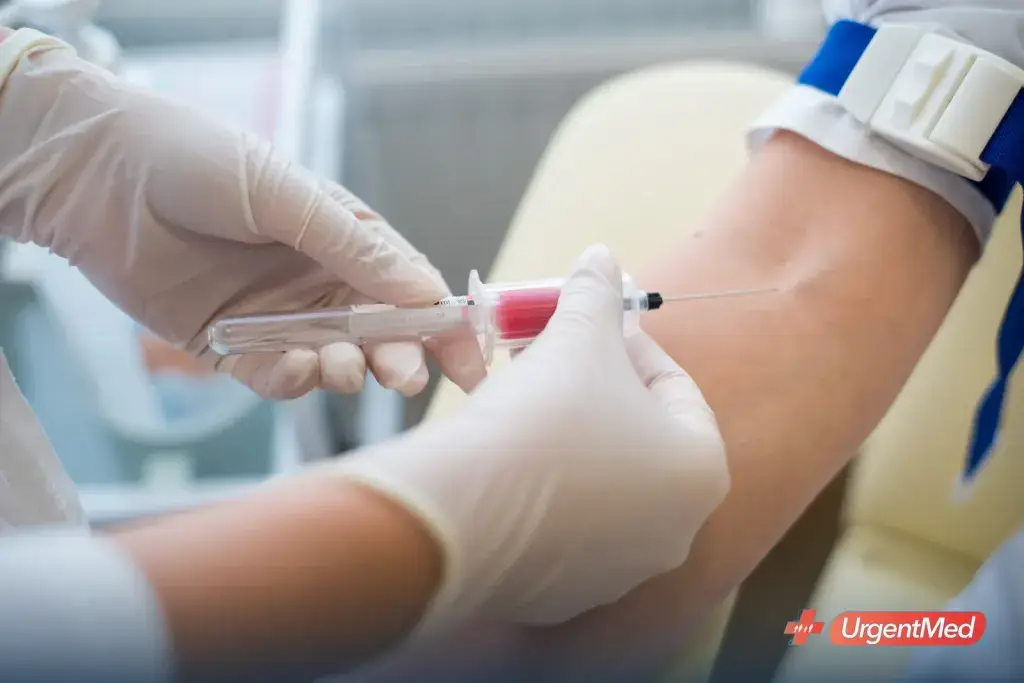
Walk in for blood work, a blood test or other lab work at UrgentMed Davie or Plantation — both clinics draw blood and collect samples on site, seven days a week, with no appointment and no separate trip to a draw station. Rapid tests are run here and read before you leave; broader panels go to the reference laboratory and come back to a provider who reviews them and contacts you. You can come in because you have symptoms, because a form requires it, or simply because you want a panel drawn today.
Walk-in blood work and lab tests at both Broward clinics
- No appointment, no referral. Walk in and ask; the provider decides with you what is worth running.
- Collection on site — venous draw, finger stick, urine and swab specimens, all taken here.
- Children too — blood is drawn from children of any age at both clinics; see pediatric urgent care.
- Rapid results during the visit for the tests that can be run here, with the provider explaining what they mean before you leave.
- Send-out panels to the reference laboratory — usually a few business days depending on the panel, with STAT turnaround available when the situation calls for it — reviewed by a provider and then discussed with you.
- Everything else in the same visit — examination, digital imaging and EKG are also on site, so one visit usually finishes the question.
- Copies where you want them — to your own physician, a specialist, a school or an employer, on your request.
Rapid tests read during your visit
These are run here and answered while you wait — which is the whole point of walking into an urgent care rather than being sent away and called back:
- Rapid strep test from a throat swab.
- Rapid influenza A and B test.
- Rapid COVID-19 antigen test.
- Rapid RSV test.
- Rapid mononucleosis (heterophile antibody) test.
- Urine hCG pregnancy test.
- Urinalysis by dipstick, with microscopy where indicated — see urinary symptoms.
- Point-of-care glucose — see diabetes and blood sugar.
Rapid tests trade a little accuracy for speed. A negative rapid result early in an illness does not always settle the question, and where that matters the provider says so and sends a confirmatory test.
Blood panels we draw: CBC, metabolic, lipid, thyroid and more
- Complete blood count (CBC) — red cells, white cells and platelets; the general screen for infection, anemia and inflammation.
- Basic and comprehensive metabolic panel (BMP / CMP) — electrolytes, kidney markers, liver enzymes and glucose.
- Lipid panel — total cholesterol, LDL, HDL and triglycerides.
- Thyroid function — TSH, with free T4 where the picture calls for it.
- Liver and kidney panels where a medication or a symptom makes them relevant.
- Iron studies, vitamin B12 and vitamin D for fatigue that has not been worked up.
- Inflammatory markers such as ESR and CRP.
- Urine culture when a specimen suggests it is warranted.
- Immunity titers for school, clinical placement and employment — see vaccines, titers and immunization records.
- Long-term glucose control is covered on the diabetes page, and confidential STD and STI testing has its own page and its own privacy handling.
If your requirement is tuberculosis screening specifically — a skin test, or the single-visit blood test — that has its own page: TB testing. If you need imaging as well as bloods for a form, both happen in the same visit.
CBC blood test: the complete blood count and the CBC with differential
The complete blood count — the CBC, also called a hemogram or full blood count — is the blood test ordered most often. One tube of blood gives:
- Red blood cells, hemoglobin and hematocrit — how well the blood carries oxygen; low values point toward anemia.
- White blood cells — the cells that fight infection. A CBC with differential also counts each of the five types of white cell, which can point toward an infection, inflammation or an allergic reaction.
- Platelets — the cells that help blood clot.
A CBC needs no fasting unless it is drawn together with a fasting lipid or glucose test. It is drawn at either clinic and sent to the laboratory, with the result usually back in a few business days — sooner when the provider orders it STAT. One value just outside the laboratory’s range is common and often means little on its own; the provider reviews the whole count with you. The MedlinePlus CBC guide explains each part.
Reasons people come in for blood work
Symptoms
- Fatigue that has lasted weeks without an obvious cause.
- An infection that is not settling the way it should.
- Unexplained weight change.
- Dizziness, palpitations or feeling faint.
- Symptoms during or after travel.
Requirements and requests
- A form, clearance or program that specifies particular tests — see clearance for surgery and physicals and clearances.
- Employer-ordered screening, billed to the employer — see screenings for employers.
- Monitoring asked for by a physician you cannot get in to see quickly.
- A baseline you simply want drawn, without a referral.
How to prepare
- Fasting — needed for a true fasting lipid or glucose result: nothing but water for nine to twelve hours. Ask the front desk before you eat; many panels do not require it, and mornings are the easy slot if yours does.
- Drink water beforehand unless you have been told not to. It genuinely makes the draw quicker and easier.
- Bring your medication list, including supplements — several of them change results.
- Bring the order or form if a physician, school or employer specified the tests, so exactly what was asked for is what gets run.
- Bring previous results if you have them. A trend answers questions a single value cannot.
- Tell the staff if you have fainted at a draw before, or if one arm should be avoided. It changes how the draw is done, and it is a normal thing to say.
Getting your results
- Rapid tests — discussed with you during the visit, and treatment started at the same visit where it is indicated.
- Send-out panels — usually a few business days depending on which tests are run, and STAT turnaround is available for certain cases. Weekend results are available. Some specialized tests take longer, and you are told which yours is before you leave.
- A provider reviews every result before it is released, and abnormal findings are called rather than left to be discovered.
- You get a copy, and it goes to your own physician or specialist on request. Ask at check-in and it is set up then.
Results are personal health information. They are released to you, and to anyone else only with your authorization — with the exception of employer-ordered testing, where what the employer receives is agreed in advance and limited to what the program requires.
Can you get blood work at urgent care? Yes — walk in
Yes. Both UrgentMed clinics draw blood on site seven days a week, without an appointment and without an order from another doctor. The provider here orders the test at the visit, after a short conversation about why you want it. Rapid tests are read while you wait; panels go to the reference laboratory and come back in a few business days. If your own physician has already given you a laboratory order, bring it and the draw is done to that order. The National Library of Medicine’s MedlinePlus lab-test guide explains what each common test measures.
When to go to the emergency room instead
- Chest pain, severe difficulty breathing, or fainting.
- Heavy bleeding that will not stop.
- Severe abdominal pain with vomiting, or vomiting blood.
- Confusion, a very high temperature with shaking chills, or a rash that does not fade under pressure.
- Any symptom that feels like an emergency — call 911 rather than waiting for a test result.
Urgent care is for problems that need attention today but are not life-threatening. If you think you may be having an emergency, call 911 — do not drive yourself.
Walk-in blood work in Davie and Plantation
Both clinics are open seven days a week, evenings and weekends included — Davie at 5149 S University Drive (Renaissance Plaza, just south of Griffin Road) and Plantation at 10199 Cleary Boulevard, Suite 10. Both serve Davie, Plantation, Cooper City, Weston, Sunrise, Southwest Ranches, Pembroke Pines, Fort Lauderdale and the surrounding Broward County communities. Spanish-speaking staff work at both clinics. Hours, maps and parking, or hold your place online before you come in.
Insurance and self-pay
Most major plans are accepted, along with workers’ compensation and auto (PIP) claims. Self-pay is itemized so you pay only for the tests that are run, and the front desk quotes the price before you are seen. Employer-ordered testing is billed to the employer account. Plans and payment.
Sources: MedlinePlus — Medical tests · MedlinePlus — Complete blood count (CBC)