
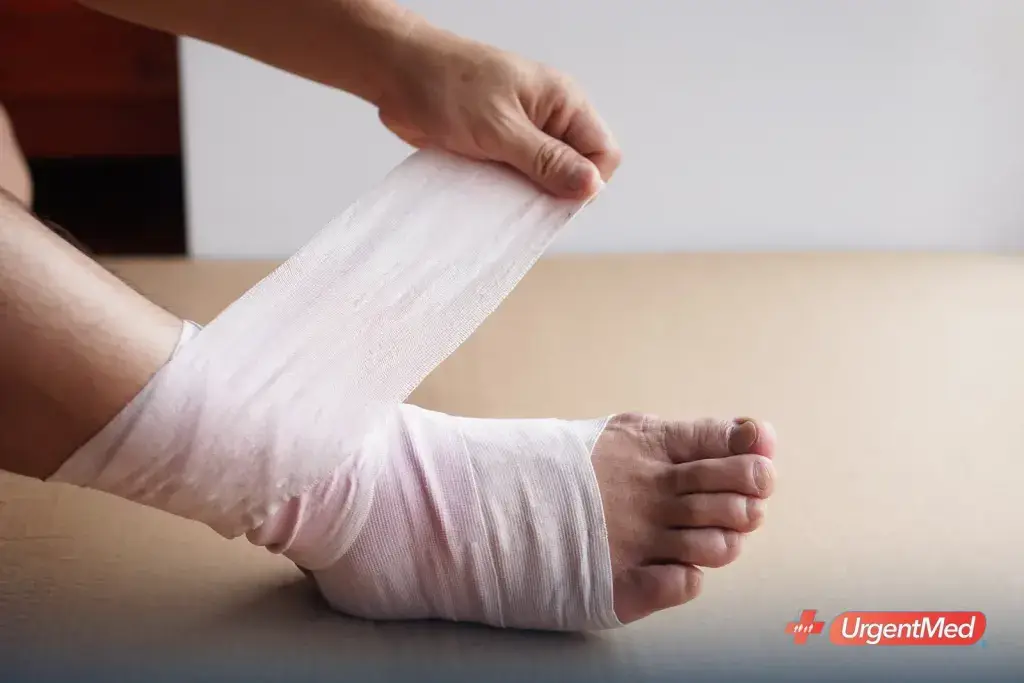
A rolled ankle on a curb, a fall onto an outstretched hand, a finger jammed at a game — the question is always the same: is it broken, and what happens now? Both UrgentMed clinics answer it in one walk-in visit — sprained ankle urgent care and fracture care with digital imaging on site, read during the visit; the splints, braces, walking boots, slings and crutches are here too, so you leave supported and with a plan rather than a referral to somewhere else.
Sprained ankle urgent care — walk-in care for sprains and suspected fractures
- One stop. Examination, imaging and immobilisation happen in the same visit at the same address — no separate imaging appointment, no second copay.
- Read during your visit by the provider treating you, so the plan is made while you are still in the room.
- Devices supplied here — splints, braces, walking boots, slings, wraps and crutches, fitted before you leave.
- Seven days a week, evenings and weekends included, which is when most of these injuries actually happen.
- Documentation in hand — work restrictions, school and activity notes, and the imaging to take to the specialist.
Injuries evaluated and treated at both clinics
Sprained ankle, foot and leg injuries — urgent care on site
- A twisted ankle that will not take weight, or that swelled quickly.
- Foot and toe injuries, including crush injuries from a dropped object.
- Lower-leg injuries after a fall, a step off a curb or a sporting collision.
- Knee injuries from a twist, a landing or a direct blow.
- Overuse injuries that have crossed from ache into pain that limits you.
Shoulder, arm and hand
- Wrist injuries after a fall onto an outstretched hand — the classic pattern for a break.
- Hand and finger injuries, including jammed and bent-back fingers.
- Elbow and forearm injuries.
- Shoulder injuries after a fall or an awkward lift.
- Rib injuries after a fall or a blow, where breathing has become painful.
What is done on site
- A focused examination — how it happened tells the provider most of what to look for.
- Digital imaging when it is indicated, read during the visit; see on-site imaging and diagnostics.
- Splinting, bracing and immobilisation fitted to the injury.
- Walking boots, slings and crutches, sized and adjusted before you leave.
- A pain-control plan you can actually follow, discussed rather than assumed.
- Wound care where the skin is broken as well — see wound care and cuts and lacerations.
- Orthopedic referral arranged where the injury needs it, with your imaging to take along.
Obvious deformity, a joint that has clearly come out of place, a bone through the skin, or a limb that is cold, pale or numb below the injury needs the emergency department, not urgent care. The list at the end of this page is worth a look before you set off.
How a sprained ankle urgent care visit works
- Tell us how it happened. The mechanism — the direction of the twist, the height of the fall, whether you could weight-bear afterwards — narrows the possibilities before anyone touches you.
- Examination. The provider checks the joint above and below as well as the injury itself, along with circulation, sensation and movement.
- Imaging when it is indicated. Not every injury needs it; the provider explains why yours does or does not. It is done here and read here.
- Immobilisation. A splint, brace, boot or sling is fitted and you are shown how to put it back on, because it will come off at some point.
- Pain and swelling plan. Elevation, ice, weight-bearing instructions and medication guidance, given specifically rather than generically.
- Follow-up and paperwork. Orthopedic referral where it is needed, a re-check here where it is not, and the notes for work, school or sport before you leave.
Sprained ankle or broken ankle — how urgent care sorts out the difference
You cannot tell reliably from pain alone, and neither can we without looking. Severe pain is common in bad sprains, and some genuine breaks hurt surprisingly little at first. What the assessment weighs:
- Whether you could bear weight immediately after the injury, and whether you can now.
- Where the tenderness is. Pain over specific bony landmarks points differently from pain over the soft tissue beside them.
- How fast the swelling and bruising appeared. Immediate swelling suggests a different injury from swelling that built up overnight.
- Movement and stability of the joint under examination.
- The imaging, where the examination leaves the question open — which is what settles it.
Some hairline breaks do not appear on a first film. If pain over a bony point is still there in seven to ten days, come back and be re-checked rather than assuming it was only a sprain — that is a normal part of the process, not a missed diagnosis.
Splints, braces, boots and crutches
The device is not decoration; it is the treatment. What is available at both clinics:
- Splints moulded to the limb for injuries where swelling is still changing — the reason a rigid device is not applied straight away in the first days.
- Braces and supports for ankles, wrists, knees and thumbs, fitted to you rather than handed over in a box.
- Walking boots for foot and ankle injuries that need to be offloaded but not fully immobilised.
- Slings and shoulder immobilisers for upper-limb injuries.
- Crutches, sized and adjusted, with instruction on stairs before you leave.
- Buddy taping and finger splints for hand injuries.
Casting is done here too, where the injury needs it. A rigid cast usually waits until the swelling has settled, so a new injury is normally splinted first and cast at the re-check — that sequence is standard care, not a limitation. Either way it is applied at the clinic rather than sent somewhere else, and you leave properly supported in the meantime with the imaging already done.
Recovery, re-checks and getting back to it
- You are given specific instructions on weight-bearing, elevation and how long to keep the device on — and what should be improving by when.
- A re-check here is arranged where the injury is one that urgent care can follow.
- Return sooner if pain is worsening rather than easing, if the device is causing numbness or new pain, or if you cannot keep up with the plan.
- Where physical therapy will help, the referral is made at the visit rather than weeks later.
- Ongoing aches without a clear injury — including long-standing joint and back complaints — are covered on the illnesses and injuries page, and joint and trigger point injections are available at both clinics.
Injuries on the job, or after a crash
The clinical care is the same; the paperwork is not, and getting it wrong on day one costs people their claims. Both clinics are set up for both routes:
- Injured on the job — UrgentMed is an authorized treating provider, and the state forms, the work restrictions and the employer reporting are handled from the first visit. Start at workers’ compensation care, or read what to do if you are hurt at work.
- Injured in a crash — Florida’s no-fault rules put a hard deadline on being seen, and missing it can end the benefit entirely. See care after a crash (PIP).
- Everyone else — most major plans, or self-pay quoted at the front desk before you are seen.
When to go to the emergency room instead
- Bone visible through the skin, or an open wound over a suspected break.
- An obviously deformed limb, or a joint that has clearly come out of place.
- A limb that is cold, pale, blue or numb below the injury.
- Bleeding that will not stop with firm pressure.
- A significant head, neck or back injury, or any injury with loss of consciousness.
- Inability to move the limb at all after major trauma, or injury from a high fall or a vehicle crash — call 911.
- A hip or thigh injury in an older adult after a fall, however well they seem.
Urgent care is for problems that need attention today but are not life-threatening. If you think you may be having an emergency, call 911 — do not drive yourself.
Walk in at either Broward clinic
Both clinics are open seven days a week — Davie at 5149 S University Drive (Renaissance Plaza, just south of Griffin Road) and Plantation at 10199 Cleary Boulevard, Suite 10. Both serve Davie, Plantation, Cooper City, Weston, Sunrise, Southwest Ranches, Pembroke Pines, Fort Lauderdale and the surrounding Broward County communities. Spanish-speaking staff work at both clinics. Hours, maps and parking, or hold your place online before you come in.
Insurance and self-pay
Most major plans are accepted, along with workers’ compensation and auto (PIP) claims; benefits are verified at check-in. Self-pay is welcome and the price is quoted at the front desk before you are seen. Plans and payment.
Sources: MedlinePlus — Sprains and strains · MedlinePlus — Fractures