
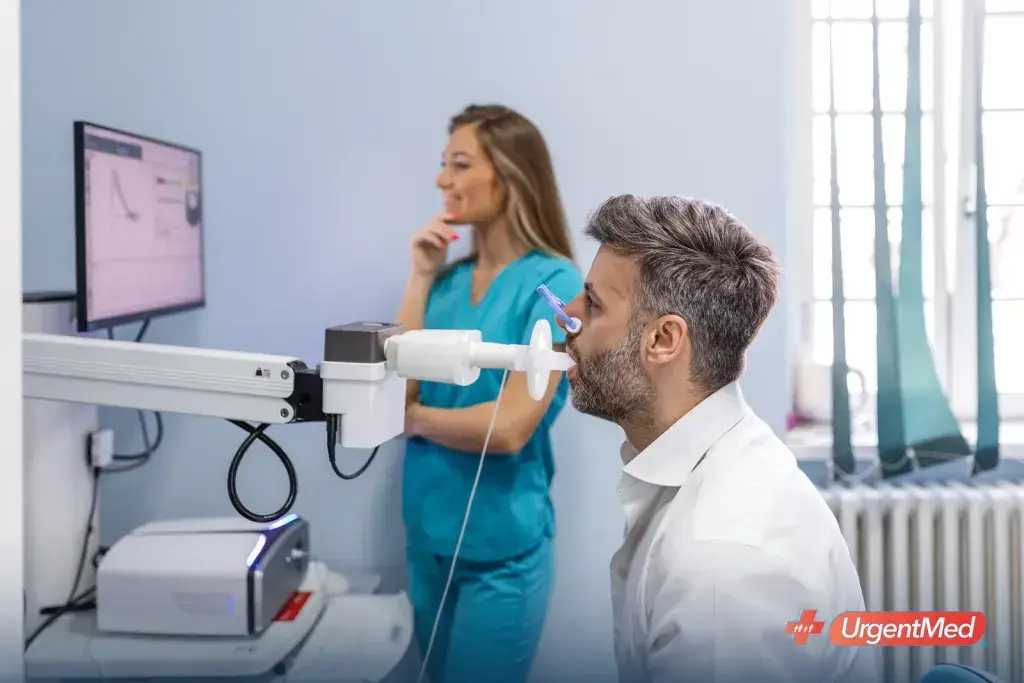
Spirometry measures how much air you can move and how fast you can move it. You blow into a tube; the machine draws the curve. It is the standard lung function test behind respirator clearance and workplace breathing programs, and it is how a provider tells an airway problem from a lung-volume problem when symptoms are not adding up. Both UrgentMed clinics perform it on site, seven days a week, walk-in.
Walk-in spirometry test at both Broward clinics
The equipment and the trained staff who coach the maneuver are at both locations. That matters more than it sounds: spirometry is effort-dependent, and a poorly coached test produces numbers nobody can act on.
- Performed and reviewed the same visit — you are not booked back for a separate appointment at a pulmonary lab.
- Coached properly, with repeat efforts until the tracings agree, because reproducibility is what makes the result usable.
- Documented for whoever asked — employer file, program administrator, or your own physician.
- Bundled with the rest of the visit where the requirement calls for it: examination, blood work, TB testing and chest imaging are all on site.
What spirometry measures
Three numbers do most of the work, and the provider reads them against reference values for your age, height, sex and ethnicity — not against a single universal figure:
- FVC — the total volume you can force out after the deepest breath you can take.
- FEV1 — how much of that volume leaves in the first second. This is the number most employer programs track year on year.
- FEV1/FVC ratio — the proportion of your total that comes out in that first second, which is what separates an obstructive pattern from a restrictive one.
- Peak flow and the shape of the curve — the loop itself often says more than the numbers, and it is also how a technically poor effort is spotted and repeated.
Spirometry describes a pattern; it does not name a disease on its own. The provider reads it with your history, your examination and your exposures, and refers you to pulmonology when the picture warrants more than urgent care can give.
Respirator clearance and employer programs
Employers send people here for two different things, and it helps to know which one you have been sent for:
- The OSHA respirator questionnaire and mask testing under 1910.134 — the questionnaire is the required part; a breathing test is added when the reviewing provider asks for one. That process, including mask testing itself, is on the respirator fit testing page.
- The exposure-driven programs that require a breathing test by rule — respirable crystalline silica (29 CFR 1926.1153) and asbestos (1926.1101) both specify one, and hazardous-waste and lead programs add it at the examining physician’s discretion. Those exams, with their imaging and blood work, are on the OSHA medical surveillance page.
- Baseline and annual testing so this year’s numbers can be compared with last year’s. Bring the previous report if you have it — a trend is worth far more than a single reading.
- Reporting the employer can file: the numbers, the interpretation and the provider’s written opinion, sent to the account rather than handed to the employee to forward. Employers can set up an account here, and see all screenings for employers.
If the visit is really a hiring exam with a breathing test attached, start at employer and new-hire physicals; if it is a commercial driver certification, start at DOT and CDL exams. Both are done here, and both can include spirometry in the same visit.
When a provider orders a breathing test for symptoms
Spirometry is also ordered when breathing symptoms have gone on too long, or are not responding the way they should. Common reasons:
- Breathing trouble on exertion that is new, or worse than it was a year ago.
- A persistent airway irritation after an infection has otherwise cleared.
- Symptoms that come and go with work, seasons or a specific environment — a pattern that only shows up when it is measured.
- A known airway condition being followed over time, or before a change in treatment.
- Clearance for diving, fire service and other roles where lung capacity is part of the standard.
Treatment for an active flare — nebulized medication and same-visit care — is on the breathing treatments page. If the problem is a chest infection rather than the airways themselves, see sinus and chest infection care. Both are treated here the same day.
How the spirometry test is done
- Height, weight and history are recorded first — the reference values depend on them, so this is not a formality.
- A nose clip goes on and you seal your lips around a disposable mouthpiece with a filter.
- You take the deepest breath you can, then blow out as hard and as fast as possible, and keep going until the staff member tells you to stop — usually six seconds, which feels much longer than it is.
- You repeat it, typically three or more times, until several efforts agree. Being coached loudly through it is normal and is the point.
- The provider reviews the numbers and the curve against the reference values and against your previous report if you brought one.
- You leave with the result explained and the documentation in hand or on its way to the employer or program.
Allow a little longer than you might expect. A good study takes coaching, and a rushed one is worth nothing to the employer who has to file it.
How to prepare for a spirometry test
- Wear clothing that does not restrict your chest or abdomen.
- Avoid a large meal in the two hours beforehand — a full stomach limits how deeply you can breathe in.
- Avoid strenuous exercise for about half an hour beforehand.
- Do not smoke or vape for at least an hour beforehand; employer programs often require longer, so check the instructions you were given.
- Bring a list of your inhalers and other medications, and follow whatever your employer or provider told you about taking them that morning — do not stop a prescribed medication on your own.
- Bring the employer form, the program instructions, and last year’s report if you have one.
Results, documentation and what happens next
- Within the expected range — the report is signed and filed, and you have a baseline for next year.
- A pattern worth acting on — the provider explains what the shape of the curve suggests, treats what can be treated here, and says plainly what needs specialist evaluation.
- A technically inadequate study — it is repeated rather than reported. A number nobody can rely on is worse than no number.
- Employer reporting — the numbers, the interpretation and the written opinion go to the account that ordered the exam, with the employee given their own copy.
When to go to the emergency room instead
- Severe difficulty breathing, or struggling to speak a full sentence.
- Blue or gray lips or fingertips.
- Chest pain or tightness with breathlessness.
- Breathlessness that came on suddenly, especially after a long flight, surgery or a leg injury.
- Confusion or drowsiness with breathing difficulty — call 911.
Urgent care is for problems that need attention today but are not life-threatening. If you think you may be having an emergency, call 911 — do not drive yourself.
Walk in at either Broward clinic
Both clinics are open seven days a week — Davie at 5149 S University Drive (Renaissance Plaza, just south of Griffin Road) and Plantation at 10199 Cleary Boulevard, Suite 10. Both serve Davie, Plantation, Cooper City, Weston, Sunrise, Southwest Ranches, Pembroke Pines, Fort Lauderdale and the surrounding Broward County communities. Spanish-speaking staff work at both clinics. Hours, maps and parking, or hold your place online before you come in.
Insurance and self-pay
Employer-ordered testing is billed to the employer account — set one up here. For everyone else, most major plans are accepted and self-pay is quoted at the front desk before you are seen. Plans and payment.
Sources: MedlinePlus — Lung function tests · NHLBI — Tests for lung disease