Sprain or Fracture? Spring Sports Injuries and When You Need an X-Ray
A rolled ankle on the soccer field, a hand thrown out to break a fall, a finger jammed by a ball: after a sports injury the first questions are whether it is sprained or broken, and whether it needs an X-ray. This guide covers the signs that point each way, first aid, when an image is worth taking, children’s growth plates, a blow to the head, and the signs that mean the emergency room.
Both UrgentMed clinics see sprains and suspected breaks as walk-ins, with X-ray and splinting on site — see sprained ankle urgent care for what the visit includes.
Sprain or fracture: what the signs can and cannot tell you
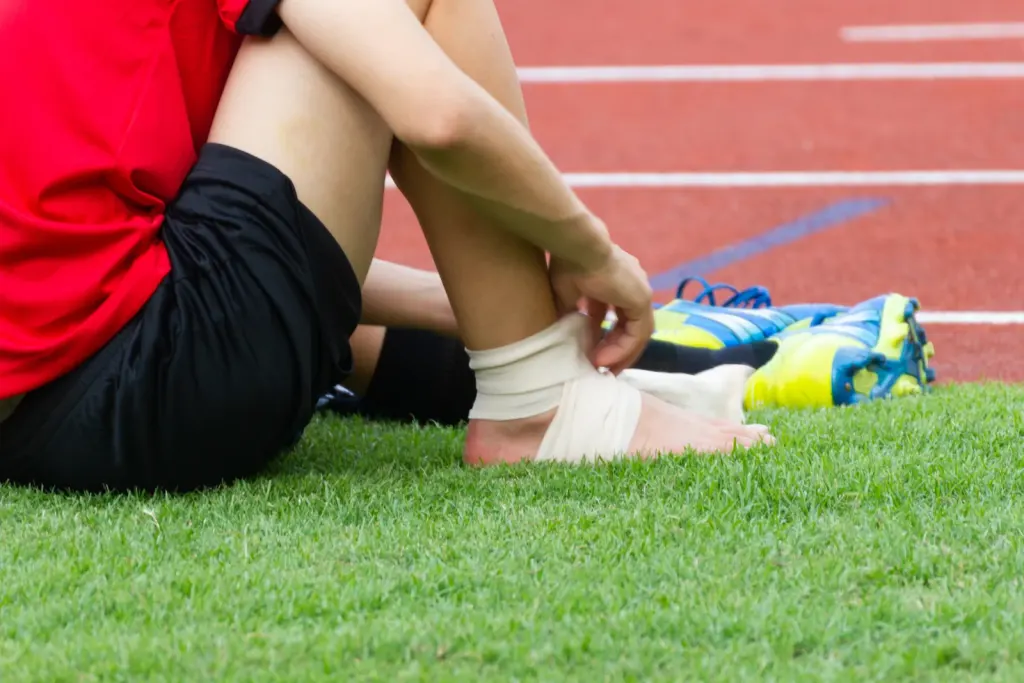
A sprain is an injury to the ligaments around a joint; a strain is a stretched or torn muscle or tendon; a fracture is a break in a bone. MedlinePlus, from the National Library of Medicine, describes the signs:
- Sprain. Pain, swelling, bruising and being unable to move the joint. For a sprained ankle, OrthoInfo — the patient site of the American Academy of Orthopaedic Surgeons — adds tenderness to the touch, pain at rest and with weight, and a feeling that the ankle is giving out.
- Fracture. A limb or joint that looks out of place or misshapen; swelling, bruising or bleeding; pain that may be severe; numbness and tingling; limited movement, or being unable to put weight on the leg; or bone pushing through broken skin.
The lists overlap. OrthoInfo notes that a severe ankle sprain can bring the same degree of pain, bruising and swelling as a fracture, which makes the two hard to tell apart — and some genuine breaks hurt surprisingly little at first. Pain alone is not a reliable guide. A clinician weighs how the injury happened, where the tenderness sits and whether you could bear weight, and an X-ray settles what the examination leaves open.
First aid in the first hours: rest, ice, compression, elevation
For a sprained ankle, OrthoInfo advises following the RICE steps as soon as possible after the injury, and MedlinePlus gives the same care for sprains in general:
- Rest. Stay off it: no walking on an injured ankle and no going back into the game.
- Ice. Apply ice right away to keep the swelling down, in an ice pack or wrapped in a towel — never directly on the skin.
- Compression. A compression bandage or wrap supports the joint and limits movement. MedlinePlus says to wrap it firmly, but not tightly.
- Elevation. Keep the ankle above the level of your heart as often as possible during the first 48 hours.
MedlinePlus adds one caution for pain relief: no aspirin for children.
If a break is possible, the first aid changes. MedlinePlus advises keeping the person still and calm, holding the injured part still with a splint or sling that supports the area above and below the injury, and applying ice packs for pain and swelling. Unless you are medically trained, leave the limb in the position you found it and never test whether the bone moves. Leave anyone with a possible neck or back injury where they are and call 911.
When does a sports injury need an X-ray?
Not every one does. OrthoInfo describes an ankle sprain as largely a clinical diagnosis, based on how the injury happened, the symptoms and the examination, with X-rays ordered depending on what those show. The findings that call for an examination, and often an image:
- Difficulty bearing weight — right after the injury, or now.
- Tenderness over the bones of the foot and ankle, rather than over the soft tissue beside them.
- A fall onto an outstretched hand followed by wrist pain — the classic pattern for a break.
- Swelling that does not start to go down within 2 days, when MedlinePlus advises contacting a provider about a sprain.
At UrgentMed the provider decides whether an image is needed and explains why yours does or does not. When it is, the X-ray is taken in the clinic and read during the visit — see urgent care with X-ray.
Some hairline breaks are not visible on the first X-ray: if pain over a bony point is still there in seven to ten days, come back and be re-checked rather than assuming it was only a sprain. X-rays evaluate the bones, and neither clinic has MRI, CT or ultrasound — when a suspected ligament tear needs an MRI, the provider refers you to an imaging center and sends the records ahead.
What the clinic visit involves
- History and examination. How it happened — the direction of the twist, the height of the fall, whether you could bear weight — then the joint above and below the injury, circulation, sensation and movement.
- Imaging when it is indicated, taken and read at the same visit. If an image needs a radiologist’s formal read or a further study, you are told before you leave.
- Support fitted before you leave — a splint, brace, walking boot, sling or crutches. A new injury that needs a cast is normally splinted first and cast at the re-check, at the clinic, once the swelling has settled.
- A plan and the paperwork — weight-bearing and elevation instructions, a re-check or an orthopedic referral with your imaging to take along, and work, school and activity notes, including return-to-play documentation.
Come back sooner if the pain is getting worse rather than easing, or the splint or brace causes numbness or new pain.
Children and teens: why growth plates change the picture
Growth plates are areas of cartilage near the ends of a child’s bones. Because they are the last part of the bone to harden, they are particularly vulnerable to injury, OrthoInfo explains, and growth plate fractures often happen in competitive sports such as football, basketball and gymnastics. The National Institute of Arthritis and Musculoskeletal and Skin Diseases (NIAMS), part of NIH, lists the signs:
- Pain and tenderness that persist after a sudden or overuse injury.
- Deformity, warmth or swelling at the end of a bone.
- A change in how the child bends the limb.
- Being unable to move, put pressure on or bear weight on the limb because of pain.
OrthoInfo advises that a possible growth plate injury be examined by a doctor as quickly as possible, and notes that some growth plate fractures that have not shifted out of place cannot be seen on X-rays. For young children, MedlinePlus advises: if a child refuses to put weight on an arm or leg after an accident, will not move it, or it is clearly deformed, assume a broken bone and get medical help.
At UrgentMed, children are X-rayed at both clinics — most often a wrist, elbow or ankle after a fall — with the technique adjusted for the child’s size, and the exposure from a limb X-ray is very small. Children are seen from age 3; for a child under 3, call their pediatrician.
A blow to the head during a game
CDC’s HEADS UP guidance is direct: when a concussion is suspected, remove the athlete from sports right away. Keep them out for the rest of that day and until a healthcare provider clears them, because the decision to return is a medical one, and athletes who return too soon have a greater chance of a repeat concussion. An athlete with a possible concussion needs to be seen by a healthcare provider.
Call 911 or go to the nearest emergency department for any of CDC’s danger signs after a bump, blow or jolt to the head:
- Convulsions or seizures (shaking or twitching).
- Not able to recognize people or places.
- Repeated nausea or vomiting.
- Unusual behavior, increased confusion, restlessness or agitation.
- Loss of consciousness with increasing drowsiness, or being unable to wake up or stay awake.
- Slurred speech, weakness, numbness or decreased coordination.
- A headache that gets worse and does not go away.
- One pupil larger than the other, or double vision.
Neither UrgentMed clinic has a CT scanner. When a head injury needs one, the provider refers you to an imaging center or the emergency room, as the urgency requires, with the records sent ahead.
Signs that mean the emergency room, not a clinic
Urgent care handles most sprains and suspected breaks in the arms, legs, hands and feet. These injuries are different:
Call 911 or go to the nearest emergency department for bone visible through the skin or an open wound over a suspected break; an obviously deformed limb or a joint that has clearly come out of place; a limb that is cold, pale, blue or numb below the injury; bleeding that will not stop with firm pressure; a significant head, neck or back injury, or any injury with loss of consciousness; or any of CDC’s head-injury danger signs above. After a high fall or a vehicle crash, or when the limb cannot be moved at all after major trauma, call 911 instead of driving yourself.
Walk in at Davie or Plantation
Walk in at Davie (5149 S University Drive) or Plantation (10199 Cleary Boulevard, Suite 10) with no appointment and no referral, or hold your place online before you come in. Spanish-speaking staff work at both clinics. Most major plans are accepted; if you are paying yourself, the price is quoted at the front desk before you are seen. Check hours, maps and parking before you go.
Sources: MedlinePlus (NIH) — Broken bone · MedlinePlus (NIH) — Sprains · MedlinePlus (NIH) — Sprains and strains · MedlinePlus (NIH) — Fractures · AAOS OrthoInfo — Sprained ankle · AAOS OrthoInfo — Growth plate fractures · NIAMS (NIH) — Growth plate injuries · CDC HEADS UP — Signs and symptoms of concussion · CDC HEADS UP — Responding to a sports-related concussion