When to Go to the ER for High Blood Pressure — and What to Do After a High Reading
Your home monitor or a pharmacy machine has just shown a higher blood pressure than you expected. This guide covers how to re-check it, what can push one reading up, the American Heart Association’s numbers, the symptoms that make it a 911 call, what to do if you feel fine, and when a walk-in visit at UrgentMed’s Davie or Plantation clinic fits.
UrgentMed’s walk-in blood pressure check rechecks a high home or pharmacy reading and assesses it the same day, with no appointment.
One high reading? Take it again, the right way
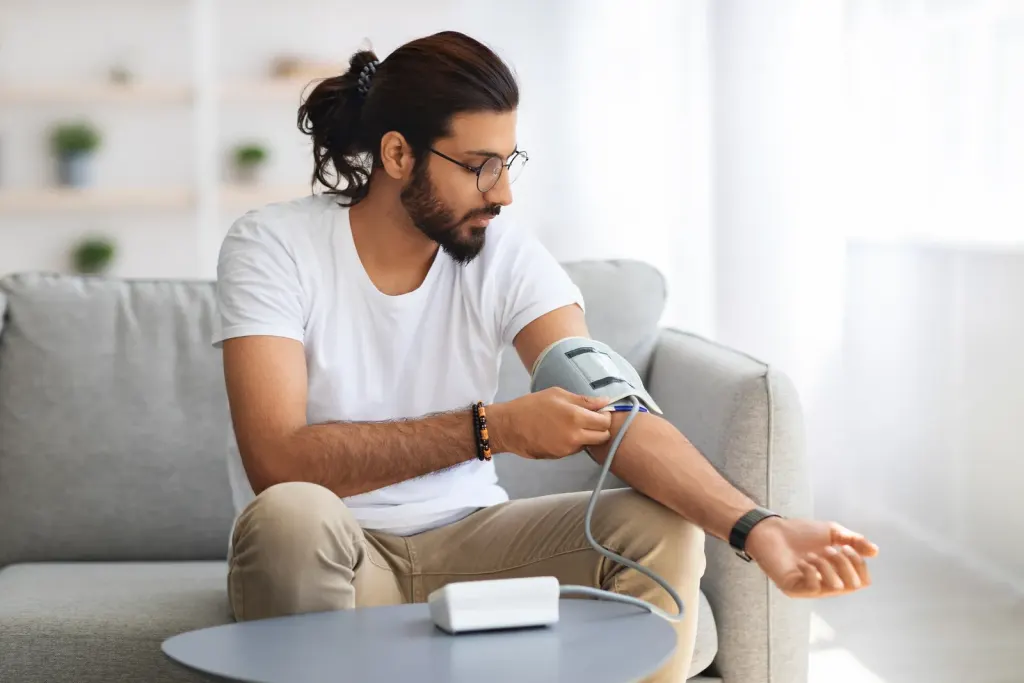
A single high reading is not an immediate cause for alarm, the American Heart Association says — but it is a reason to measure again, carefully. Its steps for a home reading, with CDC’s:
- For half an hour before, do not smoke, exercise, eat or drink — caffeine and alcohol included.
- Empty your bladder first.
- Sit with your back straight and supported, feet flat on the floor and legs uncrossed, and rest quietly before you start.
- Support your arm on a flat surface, with the middle of the cuff on your bare upper arm at heart level, fitting snugly.
- Do not talk while it reads.
- Take two readings with a short rest between them, and write both down.
The full routine, and where else to get a reading you can trust, is in where to get your blood pressure checked.
What can push a single reading up?
Plenty of things raise one reading without meaning you have high blood pressure:
- What you did just before. If you smoked, drank alcohol or caffeine, or exercised in the half hour before, CDC says your reading might be higher.
- How it was taken. A full bladder, talking, crossed legs, an unsupported arm, or a cuff that does not fit or sits over clothing.
- Stress and the time of day. MedlinePlus advises against measuring when you are under stress, and notes that blood pressure is usually higher at work and lowest during sleep.
- Nerves at the doctor’s office. As many as 1 in 3 people who have a high reading at the doctor’s office may have normal readings outside of it, according to CDC.
- What you have taken today. Decongestants, caffeine, nicotine and stimulants move the number more than most people expect.
A correctly taken reading that stays high is different: how fast to act depends on the number and how you feel.
What the numbers mean, and where the crisis line is
The American Heart Association sorts readings — the top number (systolic) and the bottom number (diastolic), in mm Hg — into five categories:
- Normal: less than 120 and less than 80.
- Elevated: 120 to 129 and less than 80.
- High blood pressure (hypertension) stage 1: 130 to 139 or 80 to 89.
- High blood pressure (hypertension) stage 2: 140 or higher or 90 or higher.
- Hypertensive crisis: higher than 180 and/or higher than 120 — “consult your doctor immediately,” the table adds.
“And/or” means either number is enough: a top number above 180, a bottom number above 120, or both. The Association’s When to Call 911 page describes a hypertensive crisis as blood pressure that rises quickly and severely, with readings higher than 180/120 mm Hg. Whether that means 911 or an urgent call to your health care professional depends on symptoms.
Above 180/120 with symptoms, or stroke signs: call 911
The American Heart Association says to call 911 if your blood pressure is higher than 180/120 and you are experiencing symptoms that may include:
- Chest pain.
- Shortness of breath.
- Back pain.
- Numbness.
- Weakness.
- Change in vision.
- Difficulty speaking.
Its instruction is plain: do not wait to see whether your blood pressure comes down on its own. Call 911 — do not drive yourself, and do not have someone drive you to urgent care. UrgentMed’s own blood pressure page adds a sudden severe headache, confusion, severe shortness of breath or breathlessness lying flat, fainting, and a very fast or very slow heart rate with the high reading to the signs that mean the emergency room.
Stroke signs are a 911 call at any reading. The American Stroke Association teaches F.A.S.T.:
- F — Face drooping. Does one side of the face droop or is it numb?
- A — Arm weakness. Is one arm weak or numb?
- S — Speech difficulty. Is speech slurred?
- T — Time to call 911. Call 911 immediately, even if the symptoms go away, and note the time they first appeared.
CDC adds sudden trouble seeing, sudden trouble walking or loss of balance, and a sudden severe headache with no known cause — and says not to drive to the hospital or let someone else drive you. The full B.E. F.A.S.T. test and heart attack signs are in ER or urgent care? How to decide.
Above 180/120 and you feel fine: what to do
If you are not pregnant, the American Heart Association calls a reading higher than 180/120 without symptoms of organ damage severe hypertension. Its steps:
- Wait, then take your blood pressure again, following the steps above.
- If the second reading is just as high, check for the symptoms in the 911 list. If you have any of them, call 911.
- If you have none, contact your health care professional as soon as possible. This usually does not need hospitalization, the Association says.
Feeling well does not make the number safe to ignore. A very high reading in someone who feels well is still worth having looked at today — and that is a visit UrgentMed’s clinics are for. Do not stop or change a prescribed medication because of one reading; take your readings to the physician who prescribed it.
Pregnant, or gave birth within the past year? The definition above is for people who are not pregnant. CDC lists urgent maternal warning signs that need medical care immediately, among them a headache that won’t go away or gets worse over time, dizziness or fainting, changes in your vision, extreme swelling of your hands or face, trouble breathing, and chest pain or a fast-beating heart. Tell whoever sees you that you are pregnant or were pregnant within the last year.
Can urgent care help with high blood pressure?
Yes — when the reading is high and you have none of the 911 symptoms. A walk-in visit can measure the pressure properly, find out why it is high today, and treat what needs treating now. At UrgentMed’s Davie and Plantation clinics that means:
- Repeat readings, correctly taken — in both arms where that is informative — and an explanation of what they mean.
- The readings interpreted alongside your pulse, your history and what you have taken today.
- An examination of your heart and lungs, and of the symptoms that separate a number from an emergency.
- An EKG on site when the picture calls for it, read during the visit.
It cannot replace ongoing care. UrgentMed does not manage hypertension over time and does not adjust long-term blood pressure medication. The provider treats what needs treating today and gives you and your physician a clear account of what was found. If the examination points to an emergency, the next stop is the emergency room.
After the visit: follow-up and long-term treatment
You leave with the readings written down, an explanation of where they sit, and a named next step — your own physician within a defined timeframe, a referral, or a recheck. If you have no physician, say so at the visit: starting that relationship is frequently the most valuable thing the visit produces.
High blood pressure is diagnosed and treated over months, not at one visit. Only a doctor or other medical professional can confirm a high blood pressure diagnosis, the American Heart Association says, and the treatment it describes depends on the category:
- Elevated: work with your health care professional to control the condition.
- Stage 1: your health care professional is likely to prescribe lifestyle changes.
- Stage 2: your health care professional should prescribe blood pressure medication and lifestyle changes.
Bring a week of home readings to that follow-up — it is what a physician needs to decide whether treatment is warranted. CDC notes that people with high blood pressure are more likely to lower it when they measure at home with their clinicians’ support.
Call 911 if your blood pressure is higher than 180/120 and you have chest pain, shortness of breath, back pain, numbness, weakness, a change in vision or difficulty speaking — or for any stroke sign: face drooping, arm weakness or speech difficulty. Do not wait to see whether it comes down, and do not drive yourself to urgent care.
Walk in at Davie or Plantation
With a high reading and no emergency symptoms, walk in at UrgentMed Davie, 5149 S University Drive (Renaissance Plaza, just south of Griffin Road), or UrgentMed Plantation, 10199 Cleary Boulevard, Suite 10. No appointment is needed, or you can hold your place online. Bring your home readings if you have them, a list of your medications including anything over the counter, and your photo ID. Spanish-speaking staff work at both clinics. Most major plans are accepted, with benefits verified at check-in; self-pay is welcome and the price is quoted at the front desk before you are seen — see plans and payment. Check hours, maps and parking before you go.
Sources: American Heart Association — Understanding blood pressure readings · American Heart Association — When to call 911 about high blood pressure · American Heart Association — Monitoring your blood pressure at home · CDC — Measuring your blood pressure · MedlinePlus — Blood pressure measurement · American Stroke Association — Stroke symptoms · CDC — Signs and symptoms of stroke · CDC Hear Her — Urgent maternal warning signs