Where to Take a Sick Child Tonight in Plantation — Urgent Care, Pediatrician or ER
It is late, your child is sick, and the pediatrician’s office is closed. The choices are a walk-in urgent care, your pediatrician’s after-hours line, the emergency room — or keeping watch at home until morning. This guide sorts them by your child’s age and symptoms, using guidance from the American Academy of Pediatrics (AAP), CDC and MedlinePlus.
Children from age 3 are seen at both UrgentMed clinics as walk-ins — see pediatric urgent care for what a visit covers.
Three places a sick child can go tonight
- A walk-in urgent care. For a problem that is not life-threatening but cannot wait for your child’s own provider. MedlinePlus lists colds, the flu, earaches, sore throats, low-grade fevers, limited rashes, sprains, minor cuts and burns, and minor broken bones. UrgentMed sees children from age 3.
- Your pediatrician’s after-hours line. If you are not sure, and none of the emergency signs on this page apply, call your child’s provider. When the office is closed, MedlinePlus explains, the call is forwarded to someone who can help — describe the symptoms and ask whether your child needs to be seen tonight. Your child’s provider or health plan may also offer a nurse advice line.
- The emergency room. MedlinePlus’s test: if your child could die or be permanently disabled, it is an emergency. Call 911 if you cannot wait to get there.
The general ER or urgent care guide covers adults too; for children, age changes the answer.
Start with your child’s age
The AAP says whether a child with a fever needs to see a doctor depends on age and the other symptoms. For the youngest, the rules are firm:
- Under two months, with 100.4°F (38°C) or higher: straight to the emergency room. Skip everything else.
- Two to 3 months old, with 100.4°F (38°C) or higher: the AAP says to call your child’s doctor right away for any baby younger than 3 months with that temperature — at night, through the after-hours line.
- Under age 3: UrgentMed sees children from age 3, so babies and toddlers should be seen by their pediatrician, who knows their history and weight-based dosing.
- Age 3 and older: urgent care fits when your child needs to be seen today, it is not an emergency, and the pediatrician’s office is closed or has no same-day visit.
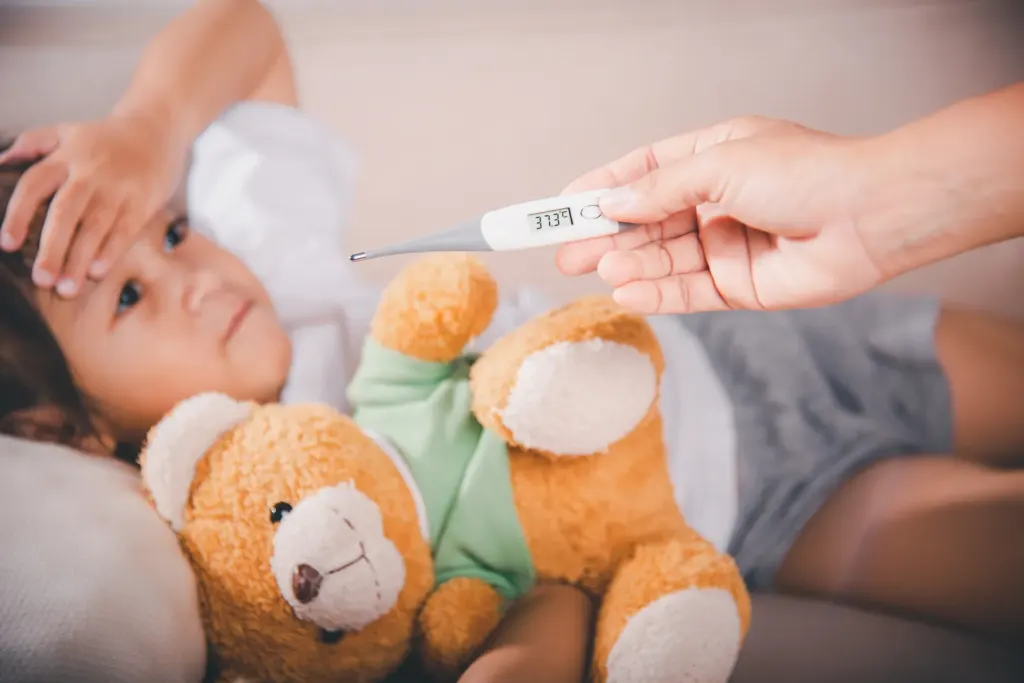
Take a baby’s temperature rectally: the AAP says rectal thermometers give the most accurate reading in babies, and a fever can’t always be detected by feeling the forehead.
Breathing and fluids come first
Whatever the age or the complaint, check these two first.
- Breathing. MedlinePlus says breathing difficulty is often a medical emergency. A child who is working hard to breathe, whose ribs pull in with each breath, or whose lips or face are turning blue goes to the emergency room. In very young infants with RSV, CDC notes, irritability, decreased activity and breathing difficulties may be the only symptoms.
- Fluids. The AAP’s warning signs of dehydration include playing less than usual, urinating less often (for infants, fewer than six wet diapers a day), a dry mouth, fewer tears and a sunken soft spot; being very fussy or excessively sleepy, sunken eyes, and cool, discolored hands and feet mean it is severe. The AAP says to notify the pediatrician immediately if any of them develop.
A child who cannot keep fluids down and has stopped making wet diapers goes to the ER, whatever the age. MedlinePlus adds vomiting or loose stools that won’t stop.
Symptom by symptom, for children 3 and older
For a child 3 or older who is breathing comfortably and keeping fluids down:
- Fever. The AAP calls fevers generally harmless. Call the pediatrician right away if a fever comes with a stiff neck, a severe headache, a severe sore throat or ear pain, breathing difficulty, an unexplained rash, or repeated vomiting or diarrhea; if your child looks very ill or is unusually drowsy; or if it rises above 104°F (40°C) repeatedly. MedlinePlus sends a high fever with headache and stiff neck, or one that won’t get better with medicine, to the emergency department.
- Cough and cold. CDC says to seek care for trouble breathing or fast breathing, dehydration, a fever lasting longer than 4 days, symptoms lasting more than 10 days without getting better, or symptoms that improve and then return or worsen. MedlinePlus adds a barking cough or wheezing. CDC does not recommend over-the-counter cough and cold medicines for children under age 6.
- Ear pain. CDC says many ear infections get better without antibiotics; see a provider for a fever of 102.2°F (39°C) or higher, pus or fluid coming from the ear, worsening symptoms, symptoms lasting more than 2–3 days, or hearing loss.
- Sore throat. CDC says to see a provider for trouble breathing or swallowing, excessive drooling in a young child, blood in saliva, dehydration, joint swelling, a rash, or symptoms not improving within a few days. Most sore throats need no antibiotics; strep throat is the exception, and a test tells them apart.
- Rashes. A limited rash is an urgent care problem, MedlinePlus says; a severe allergic reaction with trouble breathing, swelling or hives is an emergency.
At UrgentMed, rapid strep, flu, COVID-19 and RSV tests are read during the visit, and antibiotics are prescribed when the cause is bacterial and not when it is viral. Children with wheezing or an asthma flare can have a nebulizer treatment on site, and the clinics also see ear pain and ear infections, rashes, hives and insect bites, and vomiting or diarrhea with a check for dehydration.
Falls, bumps and playground accidents
Injuries are the other half of what brings families in. For children 3 and older, both clinics take digital X-rays on site and read them during the visit; sprains and simple fractures are splinted or braced, with orthopedic referral when a fracture needs it; and cuts that need stitches or skin glue are closed at the visit, numbing first. A child who hits their head is checked for concussion, and you leave with written instructions on what to watch for.
MedlinePlus sends these to the emergency department instead: a possible broken bone with loss of movement, especially if the bone is pushing through the skin; a body part near an injured bone that is numb, tingling, weak, cold or pale; and a deep wound, heavy bleeding or a serious burn. Call 911 for a head injury with passing out, throwing up or not behaving normally, an injury to the neck or spine, or bleeding that cannot be stopped.
When it can wait until morning
Not every fever or cold needs a visit tonight. The AAP says it is not always necessary for a child with a fever to see their doctor, and that it is a good sign if your child plays and interacts with you after medicine for discomfort. Keep fluids going and keep watching. Call the pediatrician, or bring your child in, if:
- Your child still “acts sick” once the fever is brought down, or seems to be getting worse.
- The fever lasts more than 24 hours in a child younger than 2, or more than 3 days (72 hours) in a child 2 or older.
For a fever-medicine dose in a child under 2, the AAP says to ask your pediatrician or pharmacist; for older children, follow the recommended dose on the label.
Call 911 for choking, a child who has stopped breathing or is turning blue, a head injury with passing out or throwing up, bleeding that cannot be stopped, or any moment you believe your child is seriously unwell. Go to the nearest emergency room for a seizure, ribs pulling in with each breath, a baby under two months with a fever of 100.4°F (38°C) or higher, a child who is suddenly very hard to wake, a child who cannot keep fluids down and has stopped making wet diapers, or a serious allergic reaction with swelling of the face or throat. For a possible poisoning, call the Poison Help line, 1-800-222-1222.
Walk in at Davie or Plantation
In Plantation, UrgentMed is at 10199 Cleary Boulevard, Suite 10, in the Publix plaza at Nob Hill Road and Cleary, across from Central Park Elementary, with parking at the door. The Plantation clinic and the Davie clinic, at 5149 S University Drive, both see children from age 3 as walk-ins, with no referral, and your child does not need to be an existing patient.
Before you leave home, check hours, maps and parking — if the clinics are closed and your child cannot wait until they open, go to the emergency room. Then check in online to hold your child’s place, so the waiting happens on your couch rather than in the lobby.
- A parent or legal guardian comes with a child under 18, or sends a signed consent with the adult who does.
- Bring the child’s medication list and allergies, the immunization record if it is handy, the name of your pediatrician, the insurance card and your photo ID.
- Spanish-speaking staff work at both clinics — ask at check-in.
- You leave with a plan, a school or daycare note, and a visit record sent to the pediatrician you name.
Most major plans and select Florida Medicaid plans are accepted — see insurance for the current list — and self-pay pricing is quoted at the front desk before your child is seen.
Sources: MedlinePlus — When to use the emergency room – child · MedlinePlus — Breathing difficulties – first aid · AAP HealthyChildren.org — Fever: When to Call the Pediatrician · AAP HealthyChildren.org — Fever Without Fear · AAP HealthyChildren.org — Dehydration · CDC — Manage Common Cold · CDC — Ear Infection Basics · CDC — Sore Throat Basics · CDC — RSV: Symptoms and Care · HRSA — The Poison Help Line